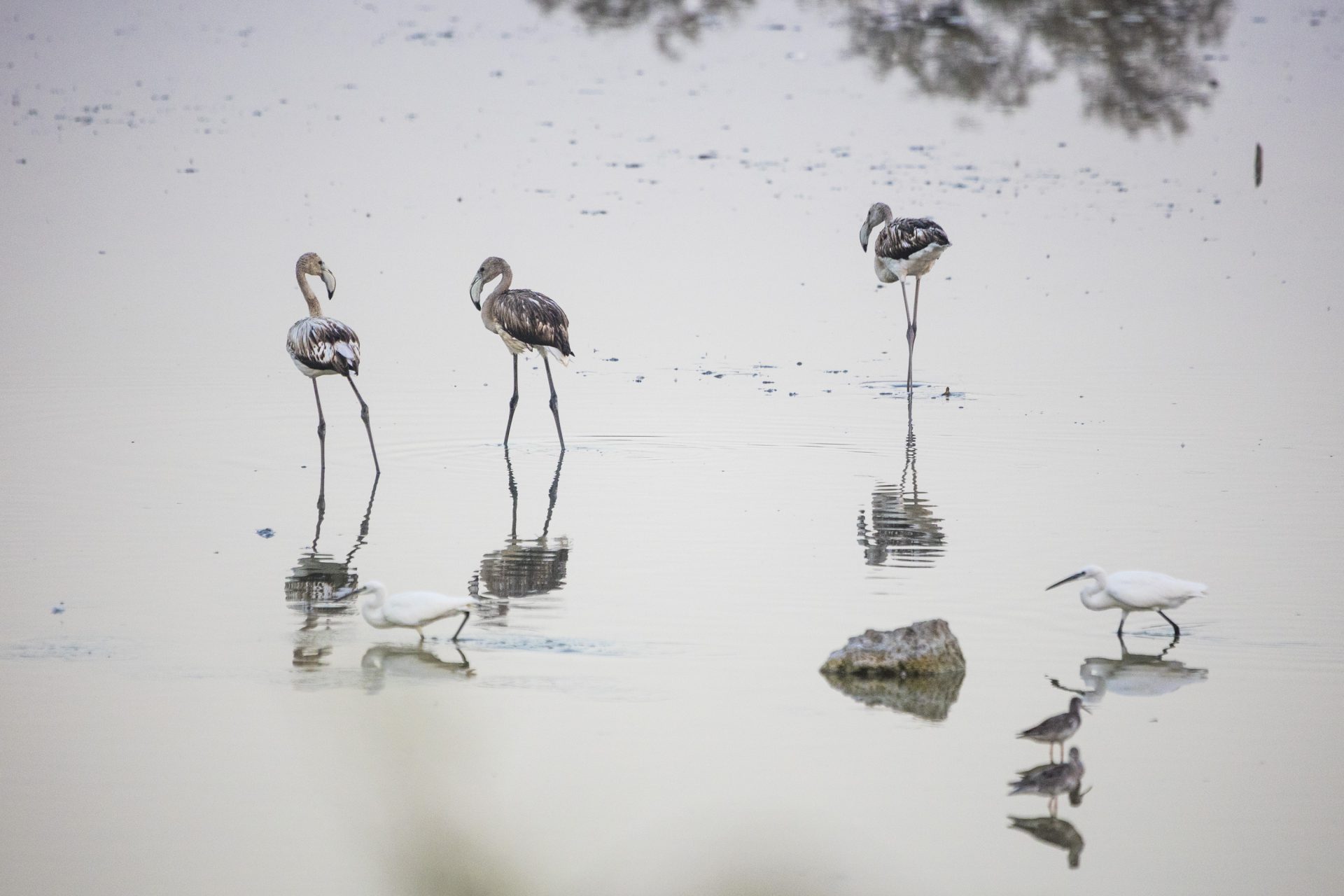
Of flamingos and composition
Before they start showing off with their pink, flamingos come into the world pretty monochromatic. They get their colors from the pigment beta carotene, which is found in the crustaceans they feed on (that’s what they do with the beak upside down in the water all day). For the same reason, those who eat huge amounts of carrots will find that their hands turn orange over time…
Beyond the bird talk, this image illustrates a composition rule that I always emphasize when guiding: creating layers. We instinctually tend to shoot two layers in an image – subject and background. It usually makes for a picture that is relatively devoid of a sense of depth. Adding another layer between us and the subject is giving a visual cue to the viewer that there is depth in the image, thus making it more three dimensional.
Here, for example, the flamingos are the subject and the background is actually the reflection of the tree (the water is not really considered a background in terms of creating the composition because it has almost no texture nor color). The waterfowl, which are soft (not sharp), add another layer between the viewer and the subject- thus adding depth to the image. And another small touch – there is a very out of focus branch in the foreground, even in front of them. It’s not there by mistake…